Ireland’s Co-location Opportunity for Utility-Scale Developers
The Single Electricity Market (SEM), encompassing Northern Ireland (NI) and the Republic of Ireland (ROI), has lofty targets for decarbonisation of the grid (report). 80% renewables is targeted by 2030, with a goal of 9GW of onshore wind, 5GW of offshore wind, and 8GW of solar.
Current renewables buildout in Ireland, coupled with high cost marginal generation has driven punchy spreads on par with its European neighbours (see Figure 1), but challenges remain for developers of standalone BESS, renewables and co-located assets alike. In this blog I will take a look at how co-location of assets could help both the system and developers alike.

Headwinds lie ahead for standalone renewable assets in Ireland’s Single Electricity Market (SEM)
One of the main challenges facing Irish renewable developers is dispatch down. Renewable assets have become victims of their own success, with wind and solar increasingly instructed to reduce output - or "dispatch down" - by the transmission system operators (EirGrid and SONI) to manage constraints and system requirements.
Constraints arise where the network cannot carry the energy to where it is needed; for example, wind farms in the west and north west, and demand centres around Dublin. All-island, encompassing Northern Ireland (NI) and the Republic of Ireland (ROI), wind and solar constraints have grown from 7.7% and 4.2% respectively in 2019 to 15.3% and 12.8% in 2026, (see Figure 2). But the all-island average hides the real picture.
In Q2 of 2026 for example, constraints hit 18.2% for the 390MW of wind assets in the North West of Ireland (ROI), whilst curtailment hit 28.4% in Midland region of Ireland in July for the 320MW of solar assets in the region.

Curtailment is also on the rise, driven by system-wide requirements: system stability (e.g. inertia requirements), frequency control and the System Non-Synchronous Penetration (SNSP) limit - the percentage of non-synchronous generation and High Voltage Direct Current (HVDC) imports allowed on the system is currently capped at 75%. Non-synchronous generation is electricity from assets that aren’t spinning in step with the grid's frequency.
In 2025 around 84% of all-island wind curtailment was driven by "high frequency” requirements, with the SNSP limit accounting for almost all of the remainder (something BESS could help with through procurement of a downward reserve instead of the current DS3 ancillary services suite which only provides an upwards provision or additional generation).
How dispatch down is compensated (or isn't)
This dispatch down behaviour is problematic across a range of contracting structures. Dispatch down compensation depends on route to market and the firmness of the grid connection. The Renewable Energy Support Schemes, RESS 3, RESS 4 and ORESS 1, are topped up to their strike price whenever available energy is lost to curtailment or oversupply, including in negative-price hours, regardless of connection firmness. RESS 1 and 2 offer very limited compensation; only where curtailment exceeds 10% in two consecutive years, and then only on the portion above 10%, with negative-price hours excluded outright. Dispatch down for constraints are not compensated under any RESS scheme making this particularly problematic for assets in congested network zones.
Assets on corporate PPAs fall back on market-level arrangements alone. A “firm” generator retains its ex-ante revenue and is settled at the better of its bid/offer price or the imbalance price up to its Firm Access Quantity (with wind and solar units essentially retaining their ex-ante revenue, as such volumes are settled at a deemed decremental price of zero). Priority dispatch generators, including some Renewable Energy Feed-in Tariff (REFIT) Scheme assets, likewise retain their ex-ante revenue. Non-firm assets, by contrast, must buy back constrained volumes at the balancing price making them highly exposed to dispatch down risk. As constraints and curtailments rise across the SEM, all assets therefore will have increasing exposure to this downside risk which must be managed.
Regulation has held Ireland back on co-location - but the tide is starting to turn
The logic of co-location is therefore obvious in Ireland. A co-located BESS can absorb energy that would otherwise be dispatched down and trade across wholesale and ancillary services much like a standalone unit. The reality is rather messier.
Until recently the connection framework offered no clean pathway to sharing the same MEC capacity. A developer adding a 30MW battery to a 40MW solar site had to apply for increased capacity of 70MW or carve the existing MEC into fixed portions, preventing efficient utilisation of grid connections. Following the Commission for Regulation of Utilities’ (CRU) April 2026 decision, a single contracted MEC can be dynamically shared between co-located generation and storage. The battery however operates as an independent registered unit, which cannot charge from renewable generation, which remains prohibited on the basis that permitting it would require wide-ranging changes across dispatch, metering, settlement and broader market design. Co-located BESS under these arrangements can therefore earn the full merchant stack, working around the constraints of our solar, but cannot touch the energy being dispatched down by the renewable asset beside it!
The alternative structure inverts our setup. Under the Renewable Electricity Support Scheme (RESS), a hybrid storage project can charge only from the renewable asset, much like a "Green Battery" in Germany. It captures curtailed energy and could participate in ancillary services, however the economics of such setups are challenging with no successful projects in RESS auctions to date. The final constraint is that co-located setups require a single legal entity behind a single connection; this could be challenging given the two asset classes demand different expertise, risk appetite and capital to make them a reality.
The regulatory tide is turning
Regulation is however moving in the right direction. The shift from demand to generation transmission charges (D-TUoS to G-TUoS) network charges from October 2026 removes a charging penalty of up to €30/MWh, improving arbitrage economics that will become increasingly critical to the BESS revenue stack. SDP-02, introduced in November 2025, opened full wholesale market participation to storage by allowing negative physical notifications. The upcoming RESS 6 auction also values storage, allocating up to 7.5% of the energy system integration score to storage, with a minimum of 1MWh of battery per MW of generation to qualify, the first time the scheme has actively rewarded co-location rather than merely permitting it.
The prize for getting co-location regulation right is compelling; better utilisation of existing connections and infrastructure. Compared to a standalone site, a co-located developer could be given the opportunity to skip connection queue and would share civils, land and grid works, reducing the marginal cost of storage. What remains to be seen is how quickly the regulatory barriers can be broken down over the coming years.
Making co-located sites bankable
The standard for making BESS units bankable in the SEM is well established. In Ireland, guaranteed, regulated DS3 ancillary services plus the Capacity Market, most recently clearing at €135k/MW in the T-4 auction, provided a highly derisked revenue stack for investors. As the SEM moves towards a more merchant stack other contracting structures will be needed as we have seen across Europe. In the standalone BESS ecosystem in Europe, floors, tolls and swaps are well understood and similar models could be translated to the hybrid space.
Contracting structures: tolls, floors and hybrid PPAs
A growing toolkit of commercial structures is emerging to make front-of-meter/utility-scale assets bankable. Under a toll or floor arrangement, the offtaker would pay our developer a fixed fee (toll - €/kW/year) or floor (minimum €/kW/year + margin), working around the dispatch of our renewables unit to monetise the BESS across wholesale and ancillary markets but this has fairly high operational risk for our offtaker. Additionally, regulation may again get in the way: the single-entity-per-MEC rule would likely need to change before this arrangement could work.
A second route is the hybrid PPA. As large corporations electrify, from logistics fleets to building heating systems, appetite is growing for long-term structures that are genuinely lower carbon rather than “green” on an annual netting basis. That appetite is sharpened by data centre (DC) load growth, where clean power is now mandated: large data centres must source at least 80% of their annual demand from renewable generation in Ireland within six years of energisation. Under a hybrid PPA, the BESS firms the generation profile and delivers a shaped output, capturing additional value per MWh delivered whilst still participating in other ancillary services.
Data centres as a new source of battery demand
Other more innovative contracting structures could also emerge in Ireland driven by data centre development, which currently consume 23% of power in the SEM, alongside large load regulation. In Ireland new data centres greater than 10MVA must build dispatchable proximate generation and/or storage capacity that can cover 100% of the site’s Maximum Import Capacity (MIC) on a derated basis; additional MW of demand cannot be brought online until this capacity is in place. These generation/ energy storage units must be front-of-meter grid-connected and metered separately to the data centre’s supply whilst participating in the capacity and wholesale electricity markets. So how much BESS would a 25MVA DC actually need to connect to the grid considering current derating factors?
Sizing BESS for data centre proximate generation

As seen from Figure 3, using the latest T-4 derating factors as specified in the regulation, a 25MVA DC would need 90MW of storage under a 4 hour configuration, contrasting with 29MW of capacity for a gas turbine. Ireland's unfavourable de-rating factors for BESS are driven by the underlying methodology, which calibrates each asset against an 8-hour Loss of Load Expectation standard - 2.7x the equivalent GB window. Short-duration batteries are heavily penalised as a result, meaning far more capacity must be built to meet the same de-rated requirement.
Sustainability-conscious data centre operators may however still adopt a full BESS strategy, despite the high de-rating factor and potential higher capital cost given the weight placed on sustainability by government and regulators in Ireland combined with gas turbine supply chain challenges. However others, as we have seen in the US, may favour a more gas-driven approach.
A hybrid approach (which I’ll model up in Gridcog in a future article) with a co-located thermal asset plus would also be permitted following the shared-MEC regulatory update. In this setup, BESS would be doing much of the trading across markets whilst our peaker plant would only play in wholesale markets across scarcity periods during the winter, meeting both regulations and sustainability needs for developers.
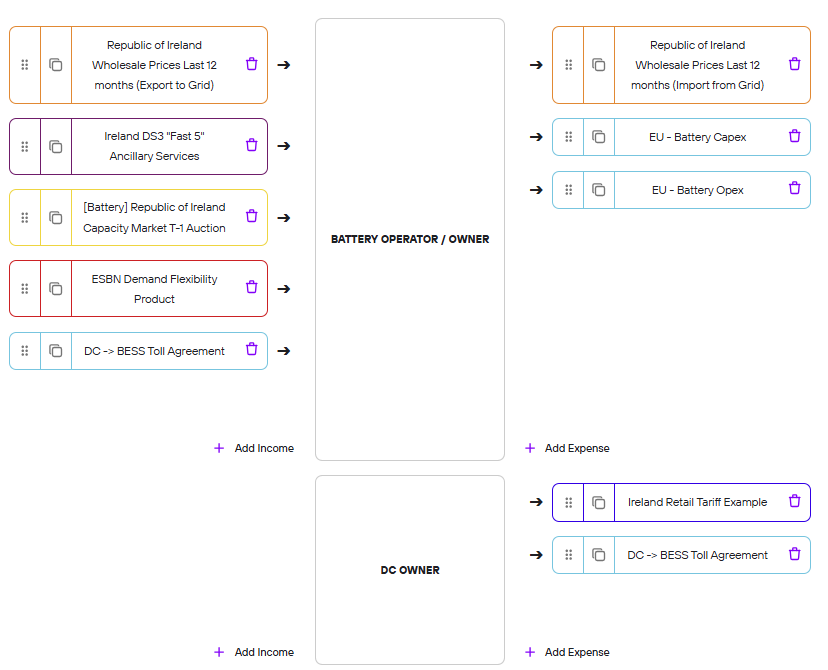
Whatever arrangement DC developers favour, BESS developers will likely have the opportunity to contract with data centres on toll-like agreements creating an alternative reliable revenue stream to the capacity market (see illustrative structure in Figure 3). Projects built to meet DC proximate generation requirements will also be able to stack capacity market revenue but will only be able to bid for rolling one-year contracts instead of the standard, highly bankable 10 years for new generation or BESS units.
These units would of course be traded by optimisers on a merchant basis across the wholesale market, DS3 and eventual Future Arrangements for System Services ancillary services alongside balancing markets as this opens up to BESS. There is also potential for BESS to provide highly localised network support for congested node/ substation, such as Google’s recent CO2 Energy Dome Project with further opportunities on the horizon as more market-based local flexibility networks develop, namely ESBN’s demand flexibility plans. For DCs this could have the added benefit of helping speed up grid connection at these constrained nodes once the energy ecosystem is comfortable with the reliability of BESS to deliver during periods of localised stress.
Commercial Setup Modelled in Gridcog
Ireland’s answer: co-locate everything
But what if we just co-locate all of these assets together in the same place? Developers could minimise grid connection and curtailment costs, whilst enabling speed-to-power through reduced regulatory hurdles, planning requirements and lighter grid connection studies. This ‘co-location of everything’ is the exact proposition in Ireland of the Large Energy User Action Plan (LEAP). The policy sets out a “plan-led approach” for large energy users (Data Centres, Advanced Manufacturing in semiconductors); the centerpiece being green energy parks where renewable generation (both onshore and offshore), storage and flexible thermal plants are co-located.
Such “plan-led” sites may be identified through spatial energy planning at nodes with high levels of constraints through to developer-led locations. This plan sets out 17 objectives to help make energy infrastructure delivery simpler for large sites through enhanced system planning, single point of contact for permitting, market designs that encourage more flexibility through strong revenue stackability opportunities, flexible/ “non-firm” grid connections and private wire development. If well executed such measures could serve as a model for European neighbours to help enable energy-intensive projects thrive in systems dominated by renewables and BESS, firmed through flexible generation.

Co-location is the answer
It is clear that developers, government and regulators are starting to converge on the same conclusion: co-location is the most efficient route to a decarbonised, reliable power system whether that means green energy parks or front-of-meter solar plus BESS. Many of the market fundamentals which can help drive co-location are now in place, chunky wholesale spreads coupled with rising demand for load and increasing dispatch down risk.
Whether Ireland gets close to its targets will come down to execution: how quickly the remaining regulatory barriers are addressed and whether the new large loads actually show up. If progress continues along this path, the system builds out more cheaply for all energy users than it otherwise would, with returns still on the table for the developers and investors who invest across renewables, BESS and flexibility.
If you’re looking to model co-location for currently constrained wind or solar assets, data centre campuses with flexible grid connections or energy parks, reach out to the team.



.jpg)