Behind-the-Meter Flex Meets the AI Data Centre Boom in GB
AI, Data Centres, and the Grid: Key Takeaways from Gridcog Unplugged London
We recently brought Gridcog Unplugged back to London for our first GB-focused edition of 2026. We gathered a room full of energy professionals in the City of London for an evening of open discussion on what accelerating AI-driven data centre demand and grid constraint challenges mean for the energy industry.
We were joined on the night by three special guest panellists with unique perspectives from across the energy ecosystem:
- Tom McCarty, Senior Investment Manager, Octopus Energy Generation
- Tom Hughes, Senior Manager, PwC (Strategy&)
- David Ferguson, Head of Innovation, EDF (UK)
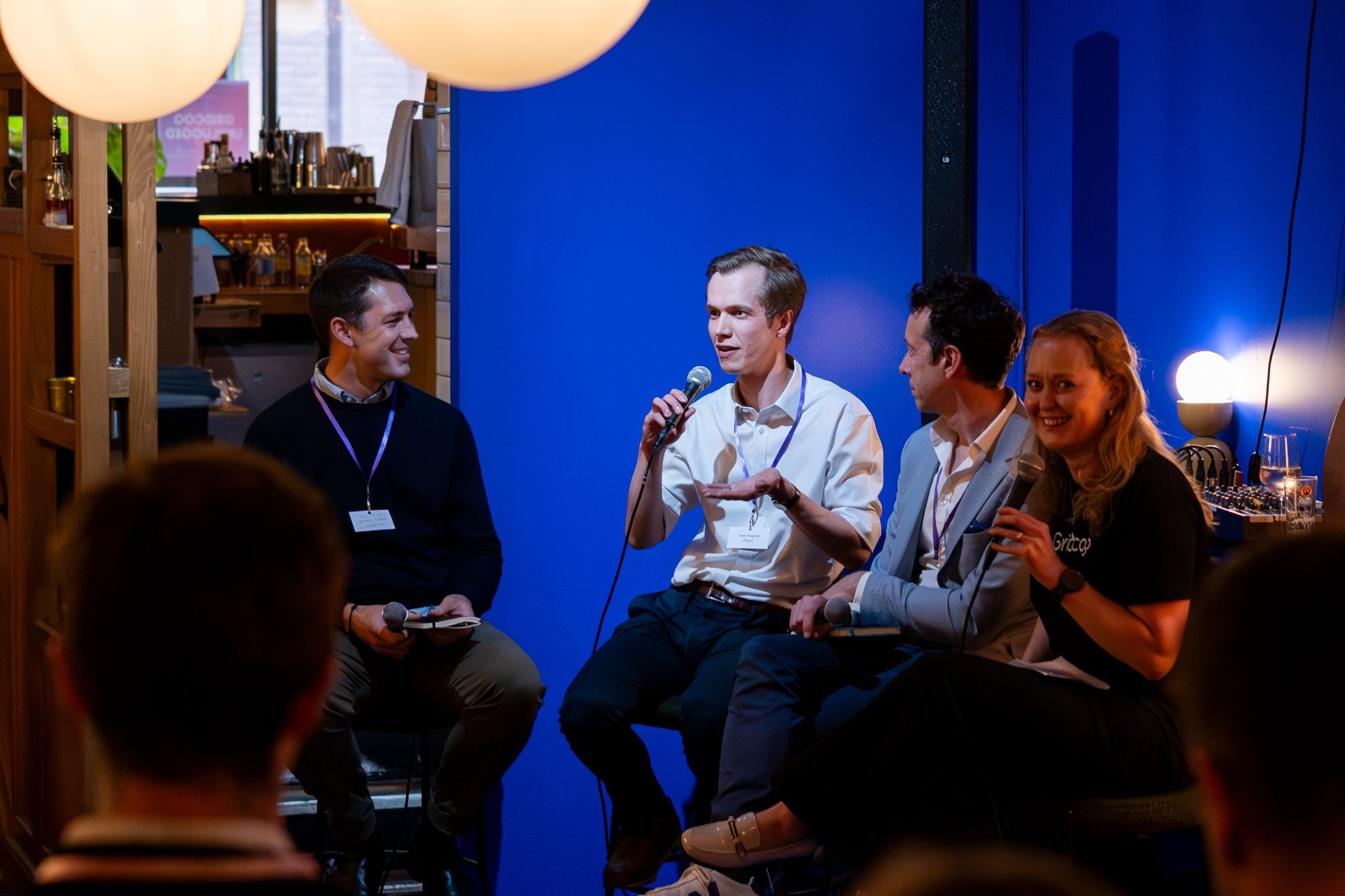
The conversation ranged widely, from sovereign AI and private co-location to forward markets for compute, 15-mile private wires, and the social impact that data centres have. Here are our key takeaways from the night.
What is actually important to data centre operators?
One of the sharpest moments of the evening came early, when the panel was asked whether data centre clients are genuinely considering revenues from participating in flexibility markets. The answer was blunt.
"The financial rewards [of flex] are irrelevant compared to operating a data centre to the level demanded by their customers."
The economics of a modern data centre, with enterprise values of £1 billion or more for a 50 MW facility, mean that the upside from demand turn-down or flex market participation simply doesn't register against the cost of any service disruption. Operators won't sacrifice availability for a modest revenue stream.
But that doesn't mean flexibility is off the table entirely. The panel was clear that the incentive structure just needs to be reframed. As one panellist put it: "Earning a little bit of money on the flex market is not it. Getting a good connection five years faster is what will motivate them." National Grid's recent work exploring exactly this kind of connection-linked flexibility model is worth watching closely as a proof of concept. There are also parallels we can draw from other markets such as the prevalence of Flexible Connection Agreements in Germany.
How are changing AI workloads unlocking flexibility?
A thread that ran through much of the discussion was the evolving nature of compute workloads, and how that evolution quietly opens the door to flexibility in ways that the current hyperscale model does not.
The training workloads that dominate today's largest data centres demand near-continuous, near-maximum power draw. Flexibility is essentially incompatible with that. But the panel argued that the shift towards inference, and particularly edge inference, changes the picture significantly.
The panel suggested that the edge data centre model, and the shift to inference away from training, may mean that some sites operate more flexibly because of the actual compute workloads they are running.
Batch inference jobs, such as an overnight NHS data run, a bank's end-of-day processing, or a video rendering task, don't necessarily need to happen right now. Some of these loads could be time-shifted. That flexibility, if structured correctly, opens up genuine optionality for the energy side of the equation.
One of the key principles the panellists emphasised is that customers who have flexibility in their workloads should be able to benefit financially from that, whether through lower energy costs, a better connection, or something else entirely.
The UK will see data centre investment, just not for the reasons you might expect
The panel pushed back on the idea that high UK energy prices will simply price the country out of AI infrastructure. The picture is more nuanced, and more interesting, than that.
Pure training workloads, large-scale model training that can run anywhere with a power connection, will largely bypass the UK. The energy economics point clearly elsewhere. But the panel identified several drivers that will bring data centre investment to Britain regardless of energy costs.
Sovereign AI is one. Batch inference, proximity to end users, data residency requirements, and access to UK AI talent were all cited as additional pulls.
The conclusion was pragmatic: customers will drive location decisions, whether through sovereignty requirements, proximity to the use case, or other factors. That means AI data centres will need to be built across regions of the UK regardless, and where they land, an energy cost will follow. Operators in that position will simply have to optimise through local renewables, PPAs, and behind-the-meter assets to manage that cost.
The contrarian view: forget gigawatts, think edge
While much of the industry conversation in GB centres on forecasts for gigawatt-scale hyperscale campuses, the panel offered a sharply different read: that the UK will see only a fraction of the large-scale data-centre capacity that it currently forecasts, but that we'll see an awful lot more small-scale edge data-centre capacity than is currently forecast.
The reasoning connects directly to the workload shift discussed above. As enterprises increasingly want private AI inference capability, not a rack in a hyperscale campus but dedicated compute they control, there is a growing market for smaller, distributed, co-location-style facilities.
The demand is already emerging. Tenants who would previously have defaulted to a hyperscale provider are now asking if they can run their workloads privately. If that trend accelerates, it has significant implications for how GB's data centre infrastructure actually develops, and for where flexibility and behind-the-meter solutions are most needed.
Why would anyone spend tens of millions on a two-year private wire?
The grid connection conversation was, as expected, one of the most practically grounded parts of the evening. The core challenge is well understood: demand is outpacing connection availability by years, non-firm connections are increasingly common, and the gap between what operators need and what the grid can currently offer is substantial.
What was most interesting was the panel's discussion of the lengths developers are already going to in order to bridge that gap. One case study stood out: a project team that seriously evaluated building a private wire from a solar farm 15 miles away, costing tens of millions of pounds, to be used for a couple of years and then decommissioned, simply to energise a data centre 12 months earlier than a grid connection would allow.
A 50 MW data centre with a high enterprise value makes a lot of unconventional economics viable. The more common version of this challenge involves customers with partial or non-firm connections trying to close the gap with local solar, batteries, and demand flexibility. It is not straightforward, but the value at stake makes it worth solving.
Making flexibility desirable: the industry's real challenge
The final thread of the evening pulled back to a broader point that is equally relevant to data centres, industrial flexibility, and the GB energy transition more generally: the industry is good at building technically sound and financially viable solutions, but not always good at making them desirable to the customers who need to adopt them.
The panel noted that flexibility, like early-stage solar, suffers from a credibility and simplicity problem. Buyers encounter either deeply technical experts who lose them in jargon, or players who overpromise and underdeliver. Neither builds the trust needed for large organisations to make significant operational changes.
The answer, the panel agreed, is to package solutions in a way that speaks to what customers actually care about, whether that is a faster connection, lower energy costs, or a simpler bill, rather than leading with the mechanics of ancillary services markets. "Make the complex simple" was the phrase that stuck. And for the data centre sector specifically, that means embedding flexibility, local renewables, and waste heat recovery into projects from the outset, so that the sustainable option is also the obvious one.
The energy in the room reflected how much is moving in this space right now, and how much still needs to be figured out.
Thanks to Tom, Tom, and David for a brilliant discussion, and to everyone who joined us and asked some excellent questions. We're already looking forward to the next one. Join our weekly newsletter list to receive insights like these every single week, and subscribe to our events calendar so you don't miss future Gridcog Unplugged events.
Genna Boyle CCO & Head of EMEA, Gridcog


.jpg)