

Understanding MiSpeL: The New Regulatory Framework for German Co-located Storage

The new MiSpeL (Market Integration of Storage and Charging Points) regulation is fundamentally changing how co-located battery assets operate and generate revenue in Germany. By allowing for multiple commercial options, the framework enables projects to shift renewable energy and capture additional revenue across various markets through bi-directional charging.
Historically, Germany supported co-located storage via innovation auctions. However, these auctions carried a significant constraint: to benefit from levies, batteries could only be charged by the co-located renewable asset. Charging from the grid was strictly prohibited.
This restriction limited wholesale arbitrage, multi-market optimisation, and ancillary service stacking. Developers were often forced to choose between a simple supported model with limited upside or a fully merchant model with significantly higher market risk.
The Shift to Flexible Co-location
Following several EEG updates, particularly the 2025 Solar Peak Act, Germany established the legal foundation for more flexible co-located storage. MiSpeL acts as the regulator’s framework to put these rules into practice.
There are two primary pathways under MiSpeL:
- The Flat Rate Option (Pauschaloption): Designed for smaller scale assets.
- The Delineation Option (Abgrenzungsoption): A precise measurement of energy flows within the site used for settlement.
While MiSpeL applies to various combinations of generation and charging assets, the benefits are most easily seen in a standard solar and battery configuration.
Understanding the Three Energy Categories
Energy flow allocation under MiSpeL occurs at a 15-minute resolution, categorising energy into three distinct streams.
1. Direct PV Export
This is solar energy produced and exported within the same quarter-hour. After accounting for any simultaneous battery charging, this volume is classified as förderfähige Netzeinspeisung. It remains eligible for the market premium, which tops up market revenues to a fixed support level.
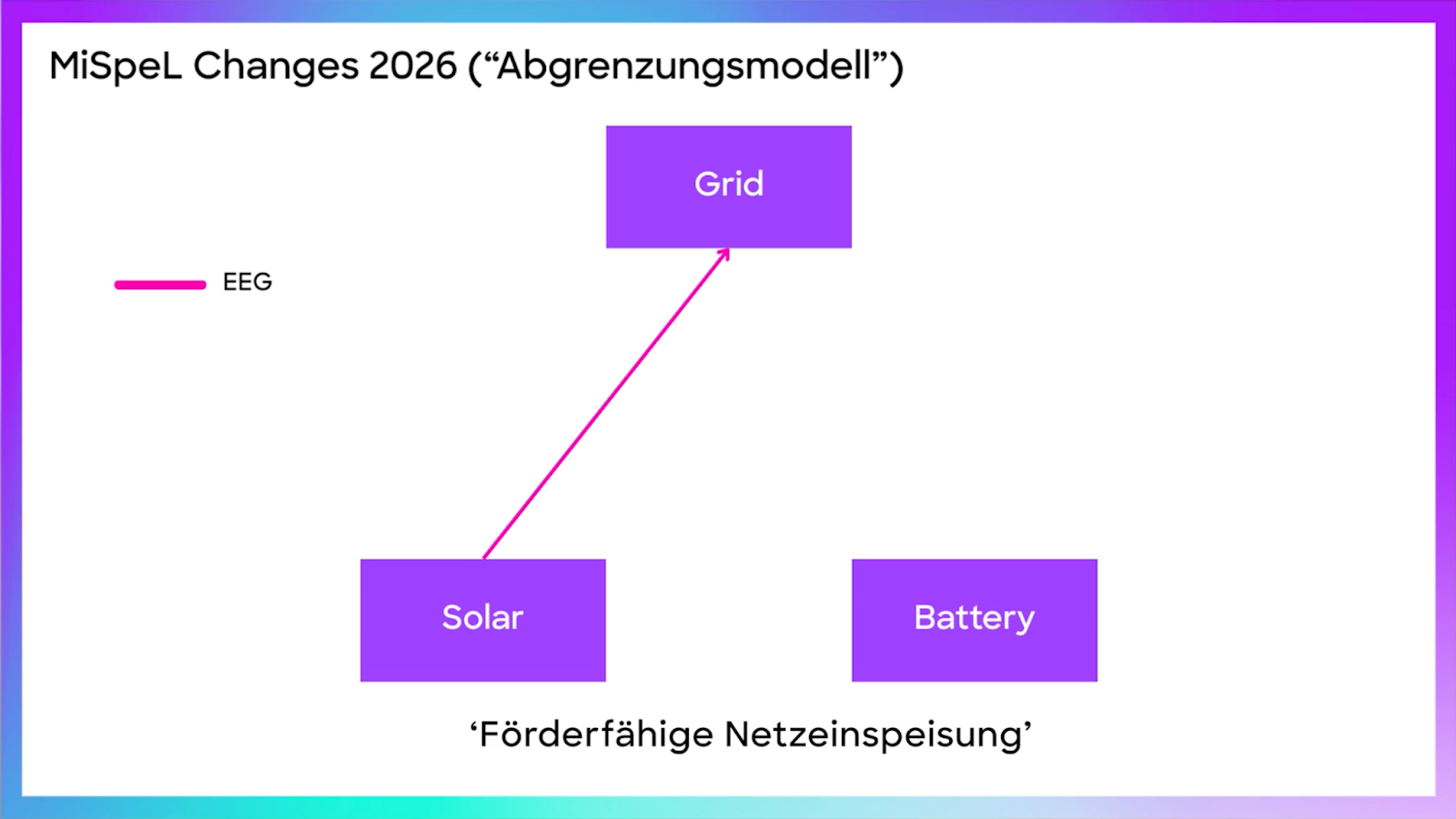
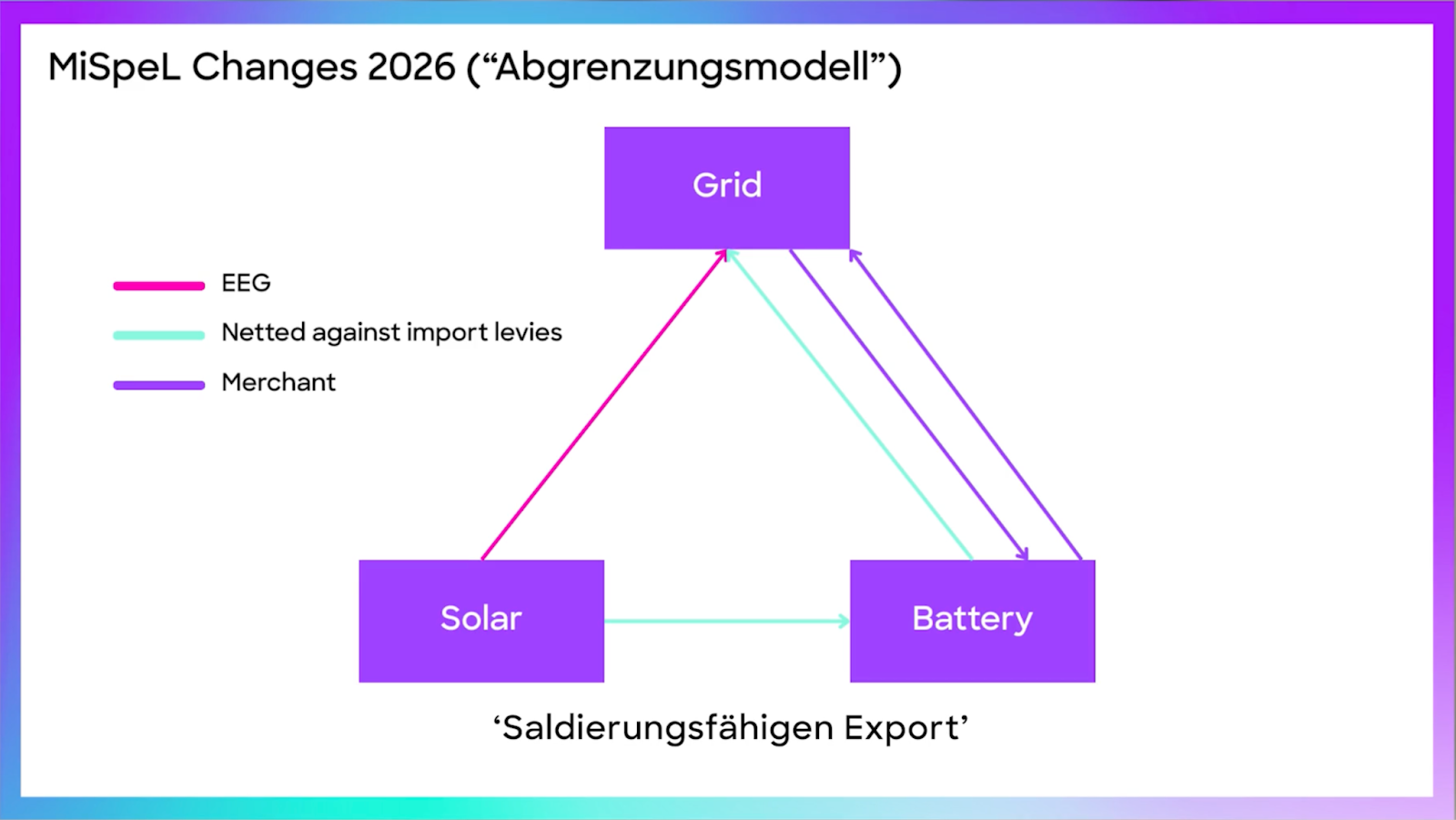
2. Time-Shifted PV Export
This involves solar energy stored in the battery and exported to the grid at a later time. While this energy is no longer eligible for a market premium, its renewable origin can be proven via quarter-hour data. It is classified as saldierungsfähige Netzeinspeisung. These volumes can be netted against grid imports when calculating levies.

3. Grid-to-Grid Energy
This refers to energy imported from the grid, stored in the battery, and later exported back to the grid. These volumes are typically subject to non-commodity costs, including taxes and surcharges
Maximising Revenue through Netting
Under the new regulation, volumes can be netted off with time-shifted solar energy. For every kilowatt-hour of nettable (saldierungsfähigen) export, one kilowatt-hour is removed from the non-commodity cost base of grid imports. The export itself receives no direct subsidy. Instead, its value is derived from avoided charges.
This creates a "middle ground" for developers. You no longer have to choose between a strictly "green-only" battery that cannot import from the grid and a fully merchant project. MiSpeL enables:
- Increased operational flexibility.
- Higher optimisation potential.
- Reduced market risk compared to pure merchant models.
Modelling MiSpeL with Gridcog
At Gridcog, we model these outcomes transparently through asset level flows. We can assign distinct pricing to direct solar export, solar export via the battery, and direct battery arbitrage with the grid.
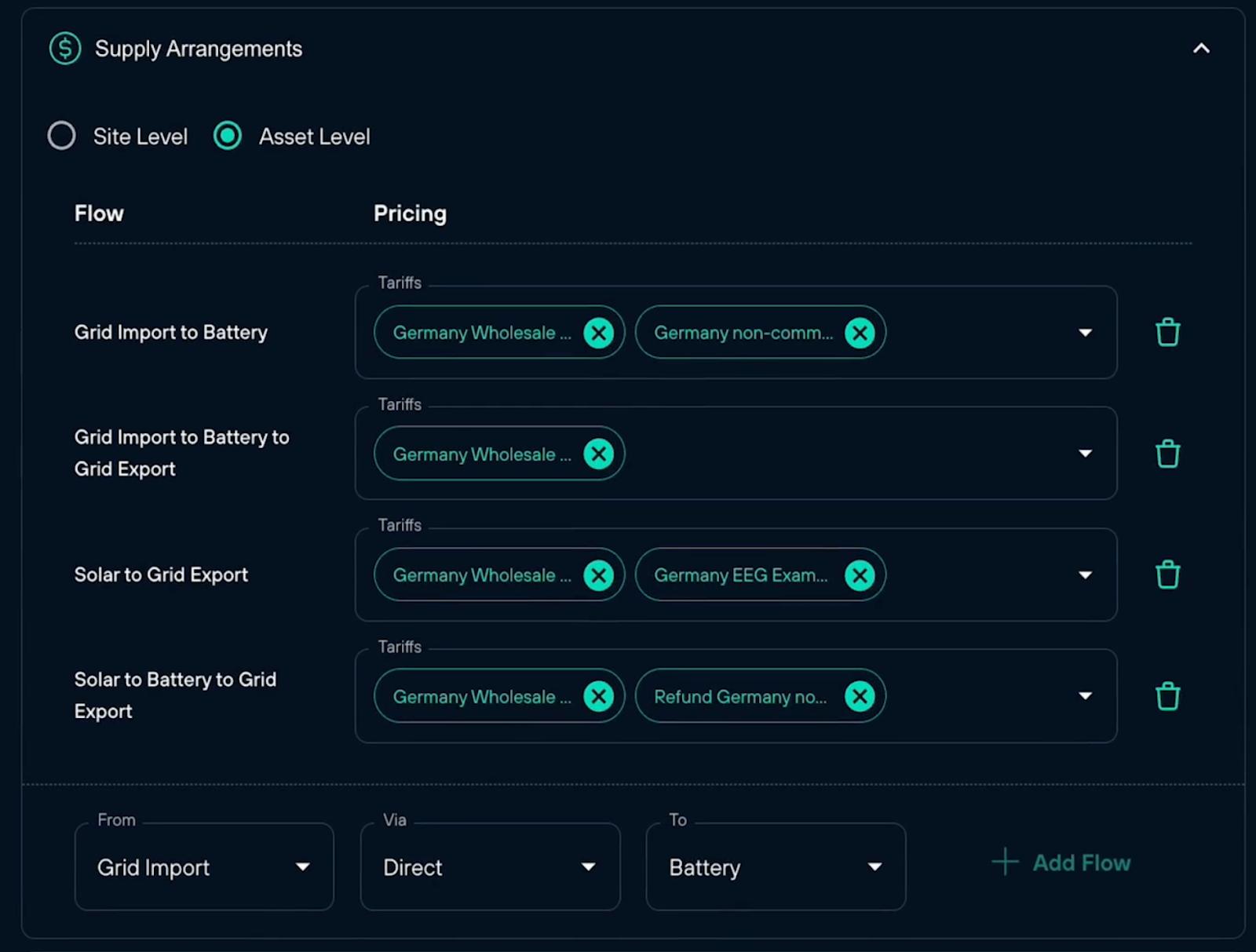
This allows you to compare different scenarios before making final investment or bidding decisions.
If you're interested in modelling the MiSpeL regulation in your energy projects, reach out to the team to discuss


.jpg)


