How much better could NEM solar farms perform with storage?

Why Solar Farms Are Adding Co-Located Battery Storage
More and more solar farms are being developed with co-located storage, or even co-located load, in response to falling capture rates in solar-heavy markets. Co-location gives the solar farm owner more options for the energy they generate during periods of negative pricing.
The Challenge for Existing Solar Farms Without Storage
For existing solar farm owners that don’t already have battery storage, deciding when and how to add a co-located BESS is an important decision. It’ll depend on the commercial performance of the existing asset as well as the potential upside from the battery.
Analysing Real Solar Farm Performance in the NEM
To see how that looks in real life, we’ve analysed five operational solar farms in the NEM, looking at the actual commercial performance for the last 12 months and see how a battery would have changed things up.
Three Scenarios for Solar Farm Revenue Modelling
- Actual solar farm output and financial performance against wholesale prices
- Modelled solar farm performance, including with economic curtailment
- The addition of a 50MW / 2-hour duration BESS to the actual sites
Why Revenue Per MW of Grid Connection Capacity Matters
To ensure a meaningful comparison, each asset’s performance is measured by annualised revenue per MW of grid connection capacity - total revenue over the period divided by its grid connection size. Grid connection capacity is scarce and expensive, so how efficiently it is monetised is a key driver of returns.
Results: Solar Farm Revenues With and Without Storage
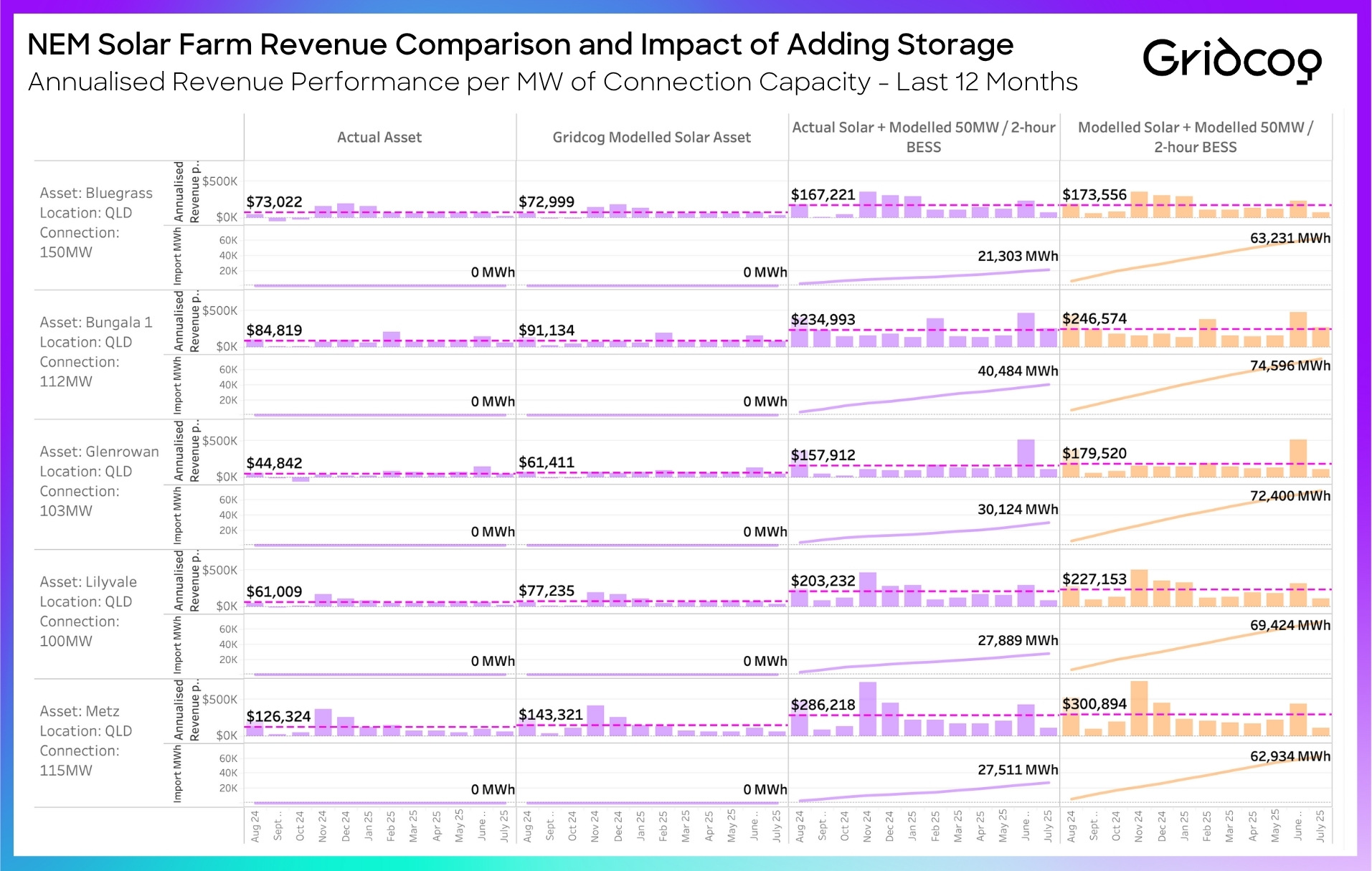
Financial performance varies significantly during months with high levels of negative pricing. This is likely driven by a combination of commercial arrangements - PPA and LGC terms in particular – as well as operational under-performance. The addition of storage has the potential to increase revenues by between 100% and 400% under perfect conditions.
Assumptions Behind the Solar + Storage Model
- Actual asset performance based on AEMO dispatch data and priced against the corresponding wholesale price. Each asset will have its own commercial arrangements in place that will impact behaviour during negative price events.
- Modelled asset performance based on the available technical info for each asset, historical irradiance data from Solcast and assuming an LGC rate of $40 per MWh, meaning economic curtailment only occurs at prices below -$40. This largely mirrors the actual site performance.
- BESS dispatch based on perfect foresight. Actual capture rates for operational BESS in the NEM are more like 60% of perfect.
- Site connection limits based on observed export data in addition to published data
How Co-Located BESS Shapes Future Solar Farm Strategies
The analysis shows that batteries can play a transformative role in solar farm economics, but the benefits depend on market conditions, contract structures, and operational performance. Curious how co-located storage could change your solar farm’s returns? Book a demo with Gridcog and model real-world revenue scenarios today.
Additional Content: Thinking Energy Video
Check out Catalina's video for another look at this topic: